GI Endoscopy · 2 min read
Ileal Carcinoid Tumor
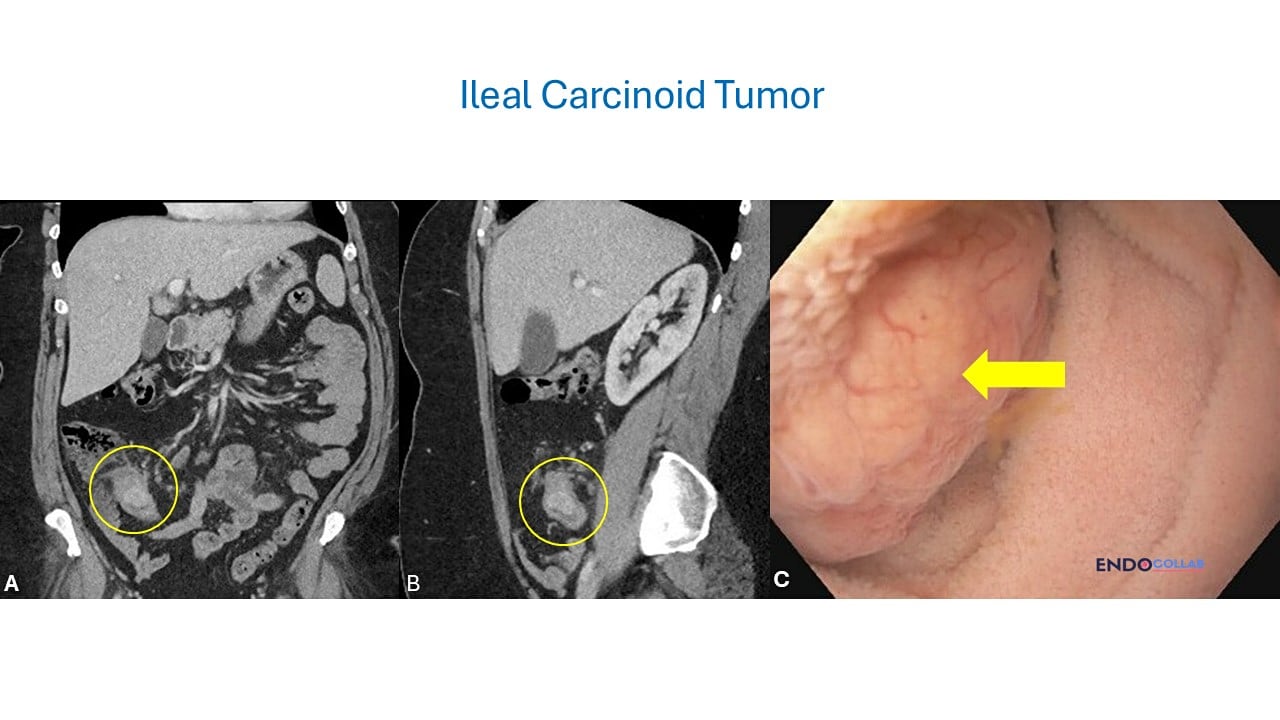
CASE REPORT
Jay Bapaye, MD, Kerry Whitt, MD. Department of Gastroenterology, Virginia Tech Carilion School of Medicine
Final Diagnosis
Ileal neuroendocrine tumor with G1 differentiation, diagnosed via colonoscopic biopsy.
Patient Demographics
A 54-year-old woman.
Clinical History
- The patient presented with two weeks of abdominal pain. She had a history of chronic constipation but was
- otherwise healthy.
- Given her new symptoms, a CT scan of the abdomen and pelvis was obtained.
- The CT scan identified a 2.6 cm hyperenhancing, pedunculated-appearing lesion within the terminal ileum
- with adjacent right lower quadrant soft tissue thickening and no lymph node enlargement, concerning for a neoplasm.
Endoscopic Findings
- During ileocolonoscopy, a large and partially lumen-obstructing mass was observed, measuring
- approximately 3 cm and located 4 to 5 cm from the ileocecal valve.
- The lesion appeared rounded and polypoid, with a yellowish color, a smooth surface with multiple
- superficial vessels, and was firm to the touch with the biopsy forceps.
Endoscopic Technique
- A colonoscopy was performed.
- Eight biopsies were obtained from the ileal lesion using biopsy forceps.
- Histology confirmed a neuroendocrine tumor with G1 differentiation.
- No complications occurred during the procedure.
Discussion
- Carcinoid or neuroendocrine tumors are slow-growing neoplasms arising from enterochromaffin cells in the
- small intestine. They account for approximately 28% of terminal ileal carcinoids.
- These tumors are frequently diagnosed late due to non-specific symptoms such as abdominal pain or
- diarrhea, at which point metastasis to the liver and lymph nodes may have already occurred. Most early carcinoids are asymptomatic, though patients may experience intermittent abdominal pain, nausea, and some weight loss.
- In the presented case, the incidental discovery on CT imaging led to the early recognition of this lesion.
- Advanced carcinoid syndrome occurs in about 10% of cases, commonly after metastasis, and is
- characterized by flushing, chronic watery diarrhea, and sweating.
- Common complications of ileal carcinoids include small bowel obstruction and intestinal bleeding. Rarely,
- tricuspid cardiac valve damage (carcinoid heart disease) occurs, but only in the setting of metastatic disease.
- Diagnostic tests for ileal carcinoid include CT or MRI scans of the abdomen and pelvis, serum blood tests
- such as chromogranin A, 24-hour urine for 5-hydroxyindoleacetic acid, and somatostatin receptor imaging (Octreoscan or PET/CT).
- Obtaining direct tissue visualization via capsule endoscopy or deep endoscopy, such as single or
- double-balloon enteroscopy with biopsies, is crucial for histological confirmation of the disease.
Key Learning Points
- Ileal neuroendocrine tumors can present with non-specific abdominal pain, making early diagnosis
- challenging.
- Cross-sectional imaging such as CT scans can be instrumental in the incidental discovery of these lesions.
- Endoscopic visualization reveals characteristic features such as a yellowish, firm, polypoid lesion with
- superficial vessels.
- Biopsy and histological confirmation are essential for definitive diagnosis and grading of neuroendocrine
- tumors.
- While often slow-growing, these tumors can metastasize and lead to carcinoid syndrome, necessitating
- prompt identification and management.
References
- Gaujoux S, Itzkowitz SH. Ileal carcinoid tumors. Gastroenterology. 2009;137(3):805-809.
- Kulke MH. Carcinoid tumors. Curr Opin Oncol. 2006;18(1):52-57.
- Ramage JK, Ahmed A, Ardill J, et al. Guidelines for the management of gastroenteropancreatic
- neuroendocrine (including carcinoid) tumours (NETs). Gut. 2012;61(1):6-32.
About the author

For your teaching file
Save this article as a PDF
Drop your email and we'll open a print-ready version you can save as a PDF — and you'll start getting our weekly GI endoscopy newsletter.